
BPM to ms Calculator
Delay Times & Note Lengths
Find tempo-synced values for your effects.
Enter your song’s BPM to calculatenote lengths, dotted eighth delays, and bar durations.Click any value to copy it.
BPM uses quarter-note beats (1 beat = 1 quarter note). Find a song’s BPM
Tap Tempo
Tempo updates after your second tap. Tap at least five times at a steady pace for a better estimate.
Click a value to copy milliseconds. These are starting points to audition. Cards show full note lengths; the Reverb Timing tab shows decay suggestions with pre-delay subtracted.
Display Settings: Sample Rate, Frame Rate & Decimals
Sample Rate
Frame Rate
Uses exactly 24, 30, or 60 fps (slightly different from 23.976 or 29.97 fps).
BPM to milliseconds formula
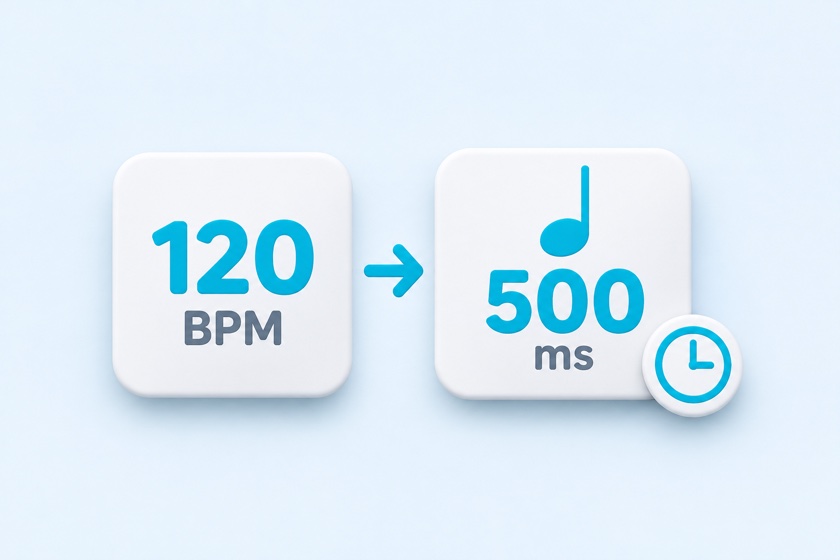
A quarter-note beat lasts 60,000 ÷ BPM milliseconds. At 120 BPM, a quarter note is 500 ms and an eighth note is 250 ms. For a note with denominator d, use (60,000 ÷ BPM) × (4 ÷ d).
Multiply a straight note by 1.5 for a dotted value, or by 2/3 for a triplet value. At 120 BPM, a dotted eighth-note delay is 375 ms and an eighth-note triplet is about 166.67 ms.
Common delay times by tempo
| BPM | Quarter note | Eighth note | Dotted eighth | Eighth triplet |
|---|---|---|---|---|
| 80 | 750 ms | 375 ms | 562.5 ms | 250 ms |
| 100 | 600 ms | 300 ms | 450 ms | 200 ms |
| 120 | 500 ms | 250 ms | 375 ms | 166.67 ms |
| 140 | 428.57 ms | 214.29 ms | 321.43 ms | 142.86 ms |
Set a tempo-synced delay in your DAW
Enter your project tempo, choose a straight, dotted, or triplet note, and copy its ms value into a delay plug-in. Try a quarter-note repeat for a clear rhythmic echo or dotted eighths for a syncopated pattern. Adjust feedback and wet/dry mix by ear.
Calculate reverb pre-delay and decay
Short note values can be starting points for pre-delay. Longer values can suggest a decay time. The Reverb Timing tab subtracts the chosen pre-delay from a note-length target to suggest a decay duration. These are musical starting points; reverb controls and measured decay behavior vary between plug-ins.
Room dimensions and early reflections
Sound travel time depends on distance and temperature. At about 68°F (20°C), sound travels roughly 343 meters per second. A reflection’s extra path length divided by that speed gives its delay relative to the direct sound. Room width alone does not specify that extra path; source and listener positions also matter.
The room examples in the calculator assume the stated geometry. Treat them as estimates, then listen and adjust.
Convert bars to seconds and video frames
Choose your time signature on the Bars ⇄ Seconds tab. In 4/4, four bars at 120 BPM last 8 seconds. To fit a set number of bars into a 15- or 30-second video, use the target-duration BPM calculation.
Frame counts use the selected exact rate: 24, 30, or 60 fps. These differ from 23.976 and 29.97 fps. Sample counts depend on your audio sample rate.
Frequently Asked Questions
How do I convert BPM to milliseconds?
For a quarter note, divide 60,000 by BPM. At 120 BPM the result is 500 ms. Halve it for an eighth note and double it for a half note.
What is a dotted eighth-note delay?
It lasts 1.5 times a straight eighth note. At 120 BPM it is 375 ms. Multiply the quarter-note duration by 0.75 to calculate it.
What is the formula for triplet delay?
Multiply the matching straight note by 2/3. An eighth-note triplet at 120 BPM is about 166.67 ms.
Does the time signature change note lengths?
Note lengths use quarter-note BPM and do not change with the time signature. The time signature changes how many note units are in a bar, so it affects bar duration.
Are the Hz values musical note frequencies?
No. They are repetition rates: 1,000 divided by the note duration in milliseconds. They can help set a tempo-synced LFO.
Can I copy or share the results?
Yes. Click a number to copy it, use Copy Table for a full table, or Copy Settings URL to share the current settings.